
For international students and early-career professionals building their future in the United States, the immigration landscape is increasingly defined by volatility. Sudden policy changes, shifting rules, and new constraints around the H-1B program, have made it clear that relying on a single pathway is no longer enough.
Amid this uncertainty, many are asking the same question: What does a stable, future-ready U.S. career strategy actually look like now?
To help bring clarity to that question, Concord recently hosted a webinar on the Stovetop Strategy and U.S. visa diversification. The session walked through the new $100,000 H-1B fee for consular cases, the latest policy updates, and the alternative pathways students can keep “warm” as they move from F-1 to OPT and into early employment. It offers a clear and candid look at how to build a resilient long-term profile.
What Is the Stovetop Strategy?
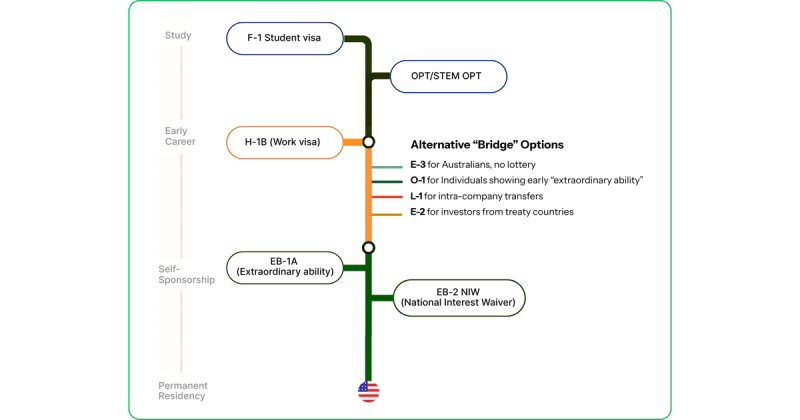
In Concord’s webinar materials, the core metaphor is simple: a stovetop with multiple pots simmering at once. Rather than relying on a single visa, especially one as unpredictable as the H-1B, students should keep several pathways in motion simultaneously. Concord shows how early options like F-1 and OPT can flow into mid-career choices such as E-3, O-1, E-2, or L-1, and later self-sponsored green card routes like EB-1A or EB-2 NIW.
This approach highlights a key truth: the viability of many advanced visas depends on what you do in your first internships, research roles, or early jobs. Evidence builds slowly, and timing matters.
Why the H-1B Alone Is No Longer a Plan
Across all three documents, Concord outlines the structural weaknesses of the H-1B as a primary strategy:
- It’s a lottery, not a guarantee.
- Even after approval, the path to permanent residency is dependent on an employer’s willingness to pursue PERM.
- The 2025 Presidential Proclamation adds a $100,000 payment for certain new H-1B petitions that must be processed through a U.S. consulate or where a requested change of status is not granted. This creates new uncertainty for international travel and employer decisions.
- In particular, F-1 students with pending H-1B changes of status may trigger the fee if they travel, cause the change of status to be denied or treated as abandoned, and are then forced into consular processing.
Concord describes this period as one of “stress and confusion,” where employers and employees alike must rethink old assumptions about timing, sponsorship, and travel.
This is exactly why the stovetop model matters.
The Alternative Pathways Every Student or Graduate Should Keep “Warm”
O-1A: Extraordinary Ability (Even Early Career)
A renewable visa for individuals demonstrating early excellence.
- Requires meeting 3 of 8 evidence criteria (awards, judging, media, original contributions, high salary, etc.).
- Fast and uncapped.
- Strong pathway to EB-1A.
Many students and young professionals qualify earlier than they think, especially with guided profile-building.
H-1B Cap-Exempt: A Stable Bridge from OPT
Jobs at universities, nonprofit research institutions, or affiliated entities are not subject to the annual H-1B cap.
- Reliable, year-round filing.
- Compatible with STEM fields and research roles.
- Allows “concurrent H-1B” with a private employer.
This path gives time to develop stronger evidence for more advanced visas.
L-1A/B: Intra-Company Transfers
For those starting their careers at multinational companies.
- Eligible after one year with a related foreign office.
- No lottery, premium processing available.
- L-1A role can provide a strong pathway to an EB-1C green card.
A classic long-term strategy for those seeking predictable employer-based mobility.
E-3: For Australian Nationals
A specialty occupation visa similar to the H-1B but far more stable.
- No lottery.
- Can be renewed indefinitely.
- 10,500 annual cap has never been reached.
With rising H-1B uncertainty, Concord anticipates increased demand, and possibly bottlenecks, making early planning important.
E-2: Treaty Investor Visa
Suitable for founders or essential employees of treaty-country-owned companies.
- Requires substantial investment in a U.S. business.
- Renewable indefinitely.
- Spouses can work incident to status.
A strong option for entrepreneurial profiles.
EB-2 NIW & EB-1A: Self-Sponsored Green Cards
Permanent residency options for individuals whose work benefits the United States or shows extraordinary ability.
- Does not require an employer.
- Strong fit for researchers, technologists, engineers, and founders in high-impact sectors.
- Requires clear, well-documented evidence of contributions.
Why Early Career Planning Matters
Concord repeatedly identifies a pattern: many applicants only begin thinking about visas when they need one. By then, opportunities to build strong evidence, publications, leadership roles, awards, judging, media visibility, critical projects, are limited.
Common issues include:
- Job codes that don’t match the intended visa.
- Weak documentation of impact.
- Missing or misaligned evidence.
- Waiting too long to seek legal guidance.
Visas like O-1A, EB-1A, and NIW reward long-term, cumulative achievements - not last-minute scrambling.
How Concord Supports Students & Early-Career Professionals
The Profile Building Program provides structured, long-range support:
- Kickoff strategy: define visa pathways and create a personalized evidence checklist.
- Quarterly attorney check-ins: monitor progress and adapt strategy as internships and roles evolve.
- Professional activities: secure peer-review roles, judging invitations, talks, media visibility, publications, and letters.
- Filing support: once thresholds are met, attorneys draft and submit O-1A, EB-1A, or EB-2 NIW petitions.
The pricing model spreads the cost over time: students pay the same total as a future visa application but gain expert support during the years when their evidence is actually being built.
Frequently Asked Questions
1. Is it still worth trying the H-1B?
Yes, but only as one option among several. The stovetop model means you pursue it while keeping stronger and more stable alternatives active.
2. Can I develop O-1A evidence while on F-1 or OPT?
Absolutely. Many indicators, publications, judging, awards, media coverage, can be built during school or early work.
3. Is the EB-2 NIW realistic for early-career professionals?
Yes, especially in national-priority fields such as AI, biotech, renewable energy, cybersecurity, and advanced manufacturing.
4. What if my employer won’t sponsor me?
For founders or independent professionals whose employer will not sponsor them, there are three powerful self-driven options. O-1A can be filed through a U.S. employer or a U.S. agent, which works well for consultants and founders serving multiple clients. EB-2 NIW and EB-1A can both be self-petitioned, so you can start your green card process without needing a traditional employer sponsor.
5. Does O-1A require publications?
No. Applicants can meet any three of eight criteria. Many business, engineering, and startup profiles succeed without academic papers.
6. What happens if I travel during a pending H-1B change of status?
Travel while an H-1B change of status is pending has always been risky, and the 2025 100,000 payment raises the stakes. Under current USCIS guidance, if you depart the United States before a requested change of status is approved, USCIS can treat that change-of-status request as abandoned. You would then need to complete your H-1B process by applying for a visa at a U.S. consulate, which may trigger the 100,000 payment if the other conditions are met. By contrast, if your H-1B change of status is approved while you are in the U.S., the additional 100,000 payment does not apply to that petition, and later travel on that approved petition does not retroactively trigger the payment. In practical terms, it is strongly advisable to avoid international travel until the H-1B change of status has been adjudicated and you have a clear, individualized legal strategy.
7. Can startup founders qualify for O-1A?
Yes. Concord documents several founders who met criteria through selective accelerators, media coverage, leadership roles, original contributions, and compensation structures.
Final Takeaway
The stovetop strategy is not just a visa plan, it’s a career philosophy. In a landscape where immigration rules shift quickly and unpredictably, the professionals who thrive are the ones who develop multiple pathways, build evidence early, and maintain flexibility across several options.
For students and recent graduates, the message is clear: start now, build broadly, and keep your long-term U.S. opportunities warm.