
Updated September 30, 2025
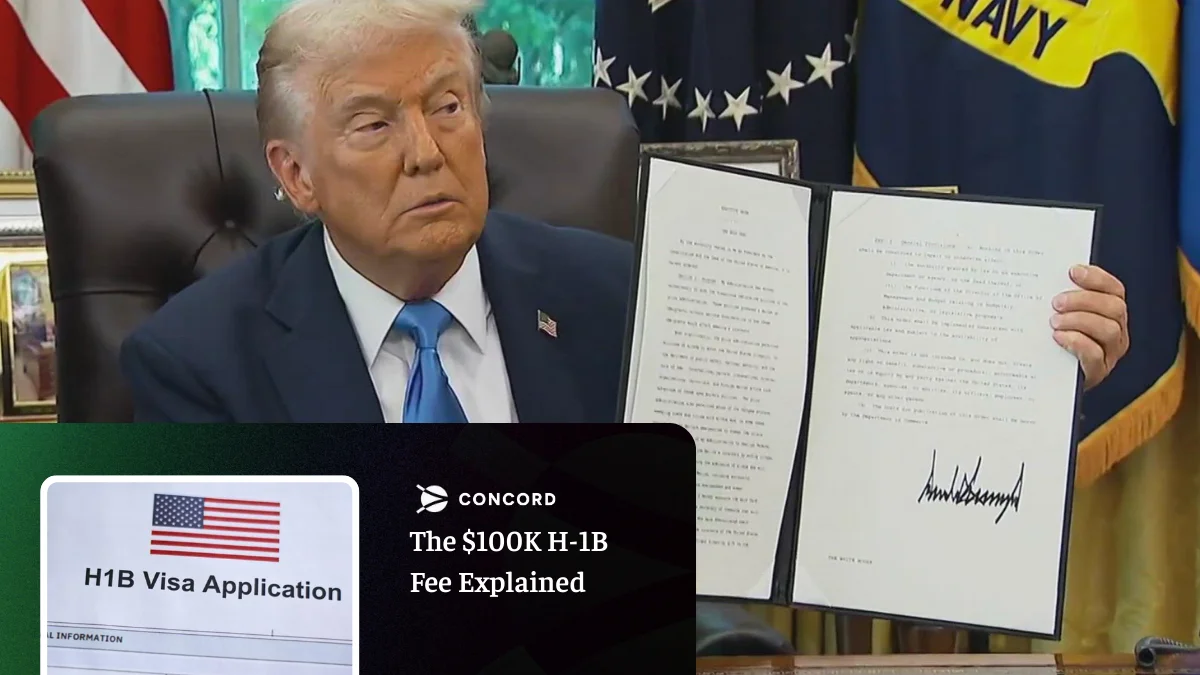
A presidential proclamation restricts entry to the U.S. in H-1B status unless a $100,000 surcharge accompanies the petition. USCIS has confirmed this is a one-time fee tied to new petitions filed on or after 12:01 a.m. EDT, Sept 21, 2025, and it does not apply to renewals or to existing H-1B holders re-entering the U.S.
Agencies are directed to rewrite wage and selection rules to prioritize higher-paid, high-skill roles. National-interest exceptions are possible. Expect implementation guidance, travel confusion at first, and litigation risk. (The White House, USCIS)
What changed in plain English
- New $100,000 surcharge on H-1B petitions and an entry restriction: the proclamation suspends entry in H-1B status unless the petitioning employer has paid a $100,000 surcharge. Effective 12:01 a.m. Eastern, Sunday 21 Sept 2025, for 12 months unless extended. (The White House)
- Not annual; not for current holders: The White House clarified this is a one-time fee per petition, first applying to upcoming H-1B cycles. Current H-1B visa holders, including those abroad, are not charged $100,000 to re-enter, and renewals are not included in the clarification. (Reuters)
- Rulemaking is coming: The order instructs Labor and Homeland Security to revise prevailing wage levels and prioritize higher-paid, higher-skill cases via rulemaking. Expect separate processes and timelines. (The White House)
- Case-by-case exceptions: DHS can grant national-interest exceptions (individual, company, or industry-wide), with procedures to be defined. (The White House)
- Update (Sept 23): DHS has since proposed a wage-based lottery reform that would prioritize higher-paid, higher-skilled H-1B petitions. (Reuters)
Who is affected vs. not affected
Affected
New H-1B petitions only. The $100,000 surcharge applies to first-time H-1B filings (e.g., new lottery entrants, new hires requiring H-1B status). (The White House)
Not affected
Existing H-1B holders (whether inside the U.S. or re-entering after travel). Renewals/extensions with the same or a new employer. (Reuters)
Government guidance so far (what’s actually on record)
- Official proclamation text sets the surcharge, entry restriction, effective time window, national-interest exceptions, and directs wage/selection rulemaking. (The White House)
- White House clarification (Press Secretary) says: one-time fee, not renewals/current holders, applies to future cycles; current holders can travel and re-enter as normal. (Reuters)
- USCIS internal memo posted online (scanned) indicates prospective application (petitions filed after 12:01 a.m. ET Sept 21, 2025) and states no impact on travel for current holders aligning with the White House clarification. (Agencies may still issue formal FAQs/cables.)
Practice alerts from AILA summarize the same effective time and scope; more agency guidance expected. (Aila)
Employer playbook
- Scenario-plan non-H-1B routes. For the near term, consider O-1, L-1, E-2 (incl. NZ), and E-3 (AUS) pipelines to avoid H-1B timing/fee uncertainty. (E-3 remains uncapped in practice and is not subject to the $100k.)
- Audit upcoming H-1B hiring plans. If you were planning to file new H-1B petitions, incorporate the $100,000 surcharge into budget scenarios; watch for national-interest waiver criteria where justifiable. (The White House)
- Travel posture for current H-1B staff. Communicate the updated White House clarification (re-entry allowed; no $100k for current holders/renewals), but warn teams to carry robust documentation and expect inconsistent frontline interpretation while guidance filters through. (AP News)
- Compensation & compliance. The proclamation foreshadows wage rule changes and priority for higher-paid roles. Start aligning job architectures and salary bands to remain competitive under a wage-tiered selection regime. (The White House)
- Exception dossiers. If you’ll seek a national-interest exception, pre-assemble an evidentiary record (critical projects, healthcare/research needs, national security linkages). (The White House)
- Exercise patience where possible. For cases that are not urgent, it may be better to hold off on filings or travel decisions until agencies issue clearer guidance. This avoids wasted costs and confusion at consulates or borders.
Individual Strategy (Workers & Candidates)
If you already hold H-1B status:
You can continue to travel and re-enter the U.S. under current White House clarifications, the $100,000 surcharge does not apply to existing holders or renewals. That said, carry robust documentation (I-797 approval, pay slips, employment letter, valid visa stamp) and prepare for border confusion in the first months.
If you are preparing a new H-1B petition:
Be ready for the $100,000 surcharge starting with upcoming lottery cycles. For many, especially startups or early-career professionals, this cost may be prohibitive. Discuss timing and alternatives with counsel immediately.
Alternative visa pathways to consider:
- O-1A / O-1B (extraordinary ability in science, business, arts, film/TV): Attractive for founders, researchers, and high-achieving professionals. No lottery, adjudicated on case-by-case evidence.
- L-1 (intra-company transfer): For employees of multinational companies moving to a U.S. branch or affiliate. Works well for larger employers with global operations.
- E-2 (Treaty Investor Visa): The E-2 is designed for citizens of countries that have a special commerce treaty with the U.S. If you’re from one of these treaty nations such as Australia, Canada, the UK, Germany, Japan, South Korea, Mexico, or Pakistan - you may qualify to live and work in the U.S. by investing in a business here.
- However, not every country has an E-2 treaty. Big players like India, China, Brazil, and South Africa are notably absent. That means nationals from these countries can’t apply directly unless they also hold dual citizenship with a treaty country.
You can see the full list of E-2 treaty countries here: U.S. State Department – Treaty Countries
- EB-2 NIW (National Interest Waiver): A green card pathway for professionals with advanced degrees or exceptional ability whose work benefits the U.S. national interest. No employer sponsorship required.
- E-3 (Australians only): Often described as the “calmer cousin” of H-1B. Annual cap of 10,500 visas — never reached. Very attractive for Australian nationals, but limited to them.
For international students (OPT / STEM OPT):
If you were planning to transition into H-1B, re-evaluate timelines. Some may shift toward O-1 or EB-2 NIW depending on profile. Immigration strategy should be started well before OPT expiry to avoid gaps in work authorization.
For dependents (H-4):
The proclamation does not directly reference dependents, but your spouse/children’s ability to stay or travel depends on the principal H-1B holder’s status. Ensure all documentation is valid, and prepare for delays at consulates.
Common questions
- Is the $100,000 fee annual?
No. The White House says it’s one-time per petition, not an annual charge. (Reuters) - Does it apply to people who already have H-1B visas?
No for current holders and renewals, per the White House clarification; the fee begins with future H-1B petition cycles. (Reuters) - Will current H-1B holders be stopped at the border without proof of the $100,000 payment?
The White House says travel ability is not impacted for current holders. Still, expect some frontline confusion until agencies issue instructions. Carry documentation. (AP News) - Who pays the fee — the employer or the worker?
The proclamation speaks to a surcharge on the petition (filed by the employer). Cost-sharing has compliance implications under DOL rules; employers should seek legal advice before recoupment. (The White House) - What about H-4 dependents?
The proclamation targets H-1B petitions. H-4 visas are not directly addressed, though a principal’s status controls family travel and status. Watch for USCIS and State guidance. (The White House) - Can the fee be waived?
Possibly, national-interest exceptions may allow petitions without the surcharge case-by-case. Criteria and process are pending. (Reuters) - Will the H-1B lottery change this year?
The proclamation directs agencies to prioritize higher wages/skills in future rules, which could reshape selection. Details come via rulemaking, not the proclamation itself. (The White House)
Source-of-truth documents
- Proclamation: “Restriction on Entry of Certain Nonimmigrant Workers” — sets the surcharge, effective time, rulemaking directives, and exceptions. (The White House)
- White House clarification (Press Secretary): one-time fee; current holders/renewals unaffected; travel ability unchanged. (Reuters)
- USCIS memo (posted online): prospective application; no change to current-holder travel; aligns with clarification.
Whether you’re navigating the new H-1B rules, exploring alternatives like O-1, L-1, or E-3, or just want peace of mind about your next steps, we’re here to help.